AirTag for cats
Where does your cat go at night?
Put an AirTag on a breakaway collar and AirTag History saves every location the Find My network reports for it, checking every 5 minutes, all night. One night gives you scattered points. A few nights show your cat's territory: which gardens, which streets, how far it goes. You read it in the morning, as a history rather than a live dot.
Last updated
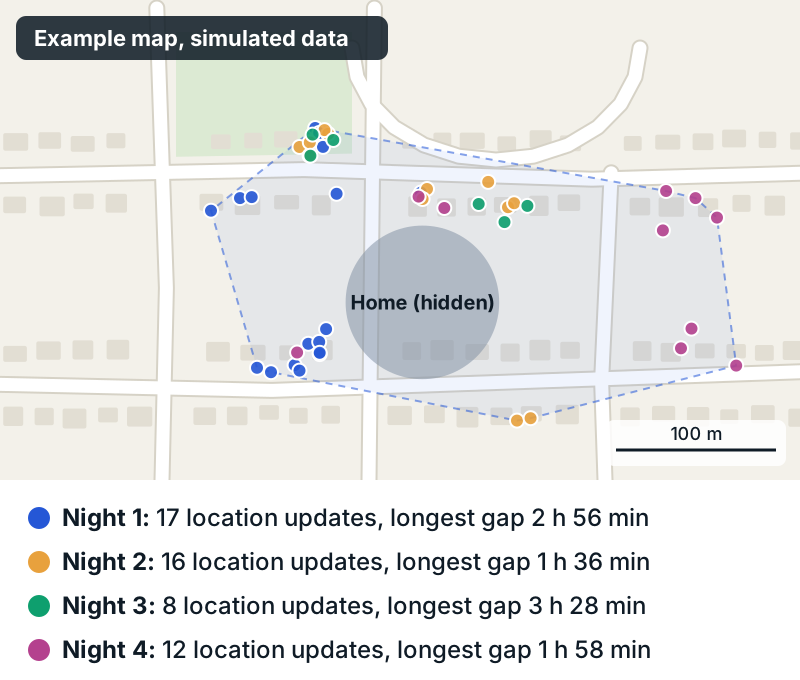
What does the map of a cat's night look like?
Dots, not a line. An AirTag has no GPS. A location exists only when someone's iPhone overhears the tag and relays its own position, so on a residential street the dots land at the houses whose phones heard the cat go by.
Gaps are part of the picture. Between dots there is often an hour or more when no phone was close enough, and AirTag History shows those gaps as gaps rather than drawing a guessed line through them.
One night on its own says little. Over several nights the same gardens and fence lines come back, and the outline of the territory appears. Find My cannot show you this, because it keeps one pin and overwrites it with every new report.
Why does an AirTag suit a cat better than a dog?
For dogs we say plainly that an AirTag is a poor pet tracker. Three things turn that around for a cat that goes out at night:
The cat goes out without you
A dog is usually out with its owner, and an AirTag next to your own iPhone tells you nothing you did not know. A cat roams alone, so every location update is news.
It roams where the phones are
GPS studies of pet cats found most stay within about 100 metres of home, favour gardens and green space, and range wider at night. Gardens sit next to houses full of iPhones, which is the network an AirTag depends on.
You are asleep
What matters is the record in the morning, not a dot to chase at 2am. Keeping that record is exactly what Find My does not do.
The research behind the second point is below.
How far do cats roam at night?
Less far than most owners fear, but farther than in the day. The largest study, published in Animal Conservation in 2020, followed 925 pet cats in six countries with GPS trackers fitted by their owners. Their home ranges averaged 3.6 hectares, a square roughly 190 metres on a side, and their activity concentrated within about 100 metres of home. Only three of the 925 ranged over more than a square kilometre.
Averages hide a wide spread. A 2014 study of 20 cats in suburban Reading, in England, measured a mean daily range of 1.94 hectares, while the biggest single day for one cat covered 33.78 hectares. The area a cat covered was significantly larger at night than during the day, and the ground it ranged over held more garden and green space than the surrounding town.
Cat Tracker South Australia, a University of South Australia project that tracked 428 pet cats, found the same on a larger sample: 88 per cent had larger home ranges at night. It also found that about 40 per cent of the cats whose owners said they were kept in at night had in fact been out, ranging over more than a hectare after dark.
How can you find out where your own cat goes?
Record it over several nights. One night shows a few places; several nights show a territory, which is the thing you actually want to know. There are three practical ways to do it:
- A GPS cat tracker: a live position anywhere with mobile signal, at the cost of a subscription and charging every few days. How it compares with an AirTag.
- An AirTag on a breakaway collar, with AirTag History saving its reports: no charging for a year and no mobile contract, but points only where a passing iPhone hears it.
- A camera at the cat flap: it tells you when the cat goes out and comes back, and nothing about where it went in between.
How do you put an AirTag on a cat safely?
Start with Apple's own position: its January 2026 announcement describes AirTag as “designed exclusively for tracking objects, and not people or pets”. That is a statement of intended use, not a lock, but it means nothing in the tag was designed around an animal wearing it. The safe setup is yours to get right.
- Breakaway collar only. Cats Protection says the safest cat collars are quick-release or snap-opening ones, because they pop open if the collar catches. Never a fixed buckle or an elastic collar.
- A holder that comes off with the collar. Avoid holders with their own strap or buckle, which can hold the loop shut after the clip has opened. When the collar releases, the AirTag should go with it, even though that means the last location may be the hedge, not the cat.
- Keep the coin battery sealed in. AirTag runs on a CR2032 lithium coin cell. Apple warns that swallowing one can cause serious injury or death, and Pet Poison Helpline says such batteries can burn an animal's oesophagus or intestines. Use a holder that encloses the whole tag, and if you think your cat has swallowed a battery, call a vet immediately.
- Weight and comfort. Apple lists the current AirTag at 11.8 grams, plus the holder. You should be able to fit two fingers under the collar. Watch the cat for the first few days and take it off if it scratches at it or changes how it moves.
The full checklist is in Is it safe to put an AirTag on a cat's collar?
What can't it do?
- No GPS and no mobile connection. A point appears only when a passing iPhone relays a sighting. Polling every 5 minutes cannot create reports nobody generated.
- Sparse in the countryside. Fields and woods have no phones in them, so a rural cat's night can come back nearly empty. If your cat roams farmland, a GPS tracker is the better choice.
- A street, not a flowerbed. A point is the position of the phone that heard the tag, which is good for a street and loose for a single garden.
- A territory, not a live route. You see where the cat has been, built up over several nights, not where it is now. There are no alerts and no geofence.
- History starts when you connect. Apple stores no history to import, so the nights before you sign up are gone.
- Neighbours may notice it. Apple says an AirTag that has been away from its owner for a while plays a sound when it moves, and that iPhones and Android phones can alert someone when an unknown AirTag is seen moving with them over time. A cat that spends hours at a neighbour's may set the sound off. If the tag travels with them, their phone can alert them, and the alert shows how to disable it. Apple does not publish the exact timings.
- Your Apple ID only. AirTag History reads the tags on the Apple ID you connect. An AirTag shared with you from someone else's Apple ID cannot be read. It is for pets and things; tracking people is prohibited.
What does it cost?
Free
$0
7 days of tracking from the moment you connect, up to 20 AirTags, no card. Then recording pauses, and everything recorded stays.
Always On
$4 a month, or $39 a year
Continuous tracking with no pass to start or expire. Cancel any time.
Per tag or per Apple ID? Per account, which means per Apple ID. One Always On subscription covers every AirTag on the Apple ID your AirTag History account connects, so two cats cost the same as one.
Frequently asked questions
Can an AirTag show where my cat goes at night?
In a built-up area, yes, as a history rather than a live position. An AirTag on a breakaway collar is located whenever a passing iPhone hears it, and AirTag History saves every one of those location updates. One night gives scattered points with gaps; several nights show the cat's territory.
How far do cats usually roam from home?
Not far for most cats. A 2020 study of 925 GPS-tracked pet cats in six countries found home ranges averaging 3.6 hectares, with the cats' activity concentrated within about 100 metres of home. Only three of the 925 ranged over more than a square kilometre.
Do cats roam further at night than during the day?
Most do. A study of 20 cats in Reading found their daily range was significantly larger at night than in the day, and the Cat Tracker South Australia project found 88 per cent of 428 tracked cats had larger home ranges at night.
Is my cat really staying in at night?
Possibly not. In the Cat Tracker South Australia project, about 40 per cent of the cats whose owners said they were kept inside at night had in fact been out, ranging over more than a hectare after dark. A tracker on the collar for a few nights settles the question.
How many nights does it take to see a cat's territory?
There is no set number. One night gives a handful of points with long gaps, because a point exists only when a phone hears the tag. Each further night adds places the earlier ones missed. Keep recording until new nights stop adding new places.
Is AirTag History's Always On priced per AirTag or per Apple ID?
Per account, which means per Apple ID. Always On costs $4 a month or $39 a year, or €4 and €39 in the euro area, and covers every AirTag on the one Apple ID an AirTag History account connects. Tracking two cats costs the same as tracking one.
Is it safe to put an AirTag on a cat?
Only with care. Apple says AirTag is designed for tracking objects, not pets. If you use one, put it on a breakaway collar that snaps open when caught, in a holder that comes off with the collar and keeps the coin battery sealed in, because a swallowed coin cell can cause serious internal burns.
Can I follow my cat live with an AirTag?
No. An AirTag has no GPS and no mobile connection, so it is located only when someone's iPhone happens to pass. What you get is a record of where the cat has been, best read in the morning. To follow a cat in real time, a GPS cat tracker with its own receiver is the right tool.
Does an AirTag work for a cat in the countryside?
Poorly. The Find My network is other people's iPhones, so it follows people. A cat in fields or woods produces few or no location updates until it comes back near houses or a road. For a rural cat, a GPS tracker is the better choice.
Can I see where my cat went before I signed up?
No. Apple keeps only an AirTag's latest location and stores no history to import, so nothing can recover the nights before you connected. AirTag History starts recording the moment you connect your Apple ID, and keeps everything from then on.
Sources
- Apple Newsroom (26 January 2026). Apple introduces new AirTag with expanded range and improved findability.
- Cats Protection. Choosing a cat collar.
- Apple Support. How to replace the battery in your AirTag.
- Pet Poison Helpline. Batteries.
- Apple Support. AirTag (2nd generation): Tech Specs.
- Apple Support. What to do if you get an alert that an AirTag, set of AirPods, Find My network accessory, or compatible Bluetooth location-tracking device is with you.
- Kays, R. et al. (2020). The small home ranges and large local ecological impacts of pet cats. Animal Conservation.
- NC State University News (11 March 2020). Keeping cats indoors could blunt adverse effects to wildlife.
- Thomas, R. L., Baker, P. J. and Fellowes, M. D. E. (2014). Ranging characteristics of the domestic cat (Felis catus) in an urban environment. Urban Ecosystems.
- University of South Australia (9 February 2017). The cat's out of the bag: secret lives of cats revealed (archived copy).
See your cat's territory
Connect your Apple ID, put the AirTag on a breakaway collar, and look in the morning. Free for 7 days, up to 20 AirTags, no card. History starts the moment you connect.